
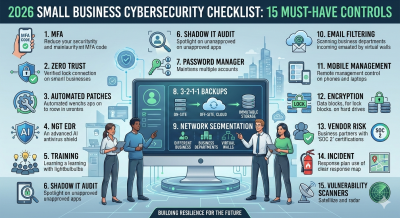
Cybersecurity threats are no longer a concern for large enterprises alone. In 2026, small businesses are increasingly targeted by ransomware, phishing scams, business email compromises, and data theft. The 2026 Small Business Cybersecurity Powerful Checklist provides a comprehensive framework to safeguard your company’s digital assets, customer data, and overall reputation.
This article will walk you through 15 essential cybersecurity controls every small business must implement to maintain a strong security posture and compliance readiness in 2026. CISA’s Small Business Cybersecurity Tips
Why Small Business Cybersecurity Matters in 2026
Small businesses are attractive targets for cybercriminals because they often lack:
- Comprehensive security budgets
- Employee cybersecurity awareness
- Up-to-date systems and software
- Robust backup and recovery strategies
According to CISA’s Small Business Cybersecurity Tips, over 60% of small businesses fail within six months of a significant cyberattack. The 2026 Small Business Cybersecurity Powerful Checklist is designed to address these risks proactively, helping small companies protect sensitive data and maintain operational continuity.
What Is the 2026 Small Business Cybersecurity Powerful Checklist?
The 2026 Small Business Cybersecurity Powerful Checklist is a structured framework of essential controls that helps organizations implement modern security practices. By following this checklist, businesses ensure that they:
- Reduce the risk of ransomware and phishing attacks
- Protect sensitive customer and employee data
- Maintain compliance with industry regulations
- Improve their overall cybersecurity posture
This checklist is especially critical for small businesses that often assume their systems are “too small” to be attacked. Cybercriminals know otherwise, making proactive security indispensable.
15 Must-Have Controls in the 2026 Small Business Cybersecurity Powerful Checklist
1. Multi-Factor Authentication (MFA) Everywhere
Passwords alone are insufficient to prevent unauthorized access. Implementing Multi-Factor Authentication (MFA) for email accounts, cloud applications, remote access tools, and financial systems adds an extra layer of protection. MFA can block more than 99% of automated credential attacks.
Learn more about securing accounts with MFA from NIST Cybersecurity Guidelines.
2. Endpoint Protection & Next-Gen Antivirus
Every device connected to your network is a potential entry point for attackers. Advanced endpoint protection should include:
- Behavioral threat detection
- Ransomware protection
- Real-time scanning
- Automatic updates
Using comprehensive endpoint solutions ensures that malware and ransomware attacks are detected before they can cause damage.
3. Regular Patch Management
Unpatched software is one of the most common ways attackers gain access. Small businesses should implement a regular patching schedule covering:
- Operating systems
- Web browsers
- CRM tools
- Accounting software
- Plugins and extensions
Automated patch management tools can simplify this process and reduce human error. For guidance, see CISA Patch Management Tips.
4. Email Security & Phishing Protection
Email remains the top attack vector in 2026. Protect your business with:
- Advanced spam filtering
- Phishing detection tools
- DMARC, SPF, and DKIM authentication
- Employee phishing simulations NIST Small Business Cybersecurity Guide
Training employees to recognize phishing emails is just as important as technical protections. Reference the NIST Phishing Prevention Guide for best practices.
5. Secure Cloud Configuration
Many small businesses rely on cloud services, but misconfigured accounts can expose sensitive data. Ensure:
- Access permissions are correctly set
- File sharing settings are restricted
- Admin privileges are limited
- Sensitive data is encrypted
Regular cloud audits help prevent accidental data leaks.
6. Data Backup Strategy (3-2-1 Rule)
Follow the 3-2-1 backup rule:
- Keep three copies of your data
- Use two different storage types
- Maintain one off-site or cloud backup SBA Cybersecurity Backup Guidance
Test your backups regularly to ensure they can be restored quickly during an incident. For guidance, see SBA Cybersecurity Backup Guidance.
7. Network Firewall & Segmentation
A properly configured firewall blocks unauthorized access. Network segmentation adds another layer of protection by isolating critical systems. Small businesses should:
- Separate guest Wi-Fi networks
- Isolate financial systems from general operations
- Limit access to sensitive databases
This limits the damage if a breach occurs.
8. Role-Based Access Control (RBAC)
Not all employees need full access to every system. Implement RBAC to:
- Apply the principle of least privilege
- Restrict access based on roles
- Audit access quarterly
This reduces insider threats and accidental data exposure.
9. Cybersecurity Awareness Training
Employees are the first line of defense. Provide:
- Quarterly cybersecurity training
- Simulated phishing exercises
- Password management guidance
- Remote work security protocols
Well-trained employees significantly reduce the risk of successful attacks.
10. Incident Response Plan
A documented Incident Response Plan (IRP) ensures your company can respond efficiently during an attack. The plan should include:
- Defined response roles
- Contact information for authorities and IT providers
- Legal and compliance steps
- Customer notification procedures
- Backup restoration process
Test your IRP annually to ensure effectiveness.
11. Zero Trust Security Model
The Zero Trust approach is the standard for 2026. It assumes no user or device is automatically trusted. Key principles:
- Verify every access request
- Continuously monitor activity
- Apply strict authentication and authorization
Even internal users must be verified, minimizing insider threats.
12. Mobile Device Management (MDM)
Remote work is here to stay. Protect mobile devices with:
- Device encryption
- Remote wipe capabilities
- App installation controls
- Secure email access
A lost mobile device should never compromise company data.
13. Encryption of Sensitive Data
Encrypt all sensitive information, including:
- Customer data
- Payment information
- Employee records
- Financial documents
Use encryption for both data at rest and data in transit. This ensures stolen data cannot be exploited.
14. Vendor & Third-Party Risk Assessment
Your security is only as strong as your weakest vendor. Before working with third parties:
- Review their security policies
- Confirm compliance certifications
- Sign data protection agreements
Supply chain attacks are on the rise in 2026.
15. Compliance & Security Audits
Regular audits help maintain strong cybersecurity and compliance:
- Review adherence to industry standards
- Evaluate internal policies
- Conduct vulnerability assessments
- Schedule at least one comprehensive audit per year
Bonus: Work with a Managed Security Provider
Small businesses often lack in-house cybersecurity teams. Partnering with a trusted provider like Blackhawk MSP can provide:
- 24/7 monitoring
- Threat detection and incident response
- Security updates and patch management
- Compliance guidance
Managed services ensure your company follows the 2026 Small Business Cybersecurity Powerful Checklist without hiring a full internal team.
Final Thoughts: Make 2026 the Year You Secure Your Business
Cyber threats are constantly evolving, and small businesses can no longer afford reactive security strategies. Implementing the 2026 Small Business Cybersecurity Powerful Checklist allows you to:
- Reduce ransomware and phishing risks
- Protect customer and employee trust
- Ensure regulatory compliance
- Safeguard revenue and business operations
Start with these 15 essential controls, review them quarterly, and continuously improve your defenses. Cybersecurity is no longer optional—it’s a core requirement for long-term success.