
MDR vs. MSSP: Which Managed Security Model Fits Your Business?
The cybersecurity landscape is no longer a simple game of “firewall and forget.” As organizations integrate sophisticated technologies—including generative AI—the attack surface has expanded exponentially. One of the most pressing concerns for modern leaders is how to prevent employees from leaking company data into AI tools while maintaining operational speed.
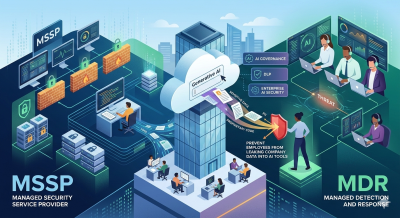
Deciding between Managed Detection and Response (MDR) and a Managed Security Service Provider (MSSP) is a pivotal strategic move. While both offer external support, they serve different masters: one focuses on the hygiene and administration of your perimeter, while the other hunts for active threats within your environment.
In this guide, we will break down the fundamental differences, explore how each model addresses enterprise AI security, and help you determine which partnership will best protect your intellectual property in an era of rapid digital transformation.
Understanding the Core Differences: MDR vs. MSSP
To the uninitiated, these two acronyms might seem interchangeable. However, in practice, they represent two distinct philosophies of defense.
What is an MSSP?
A Managed Security Service Provider (MSSP) is essentially the “night watchman” of your digital estate. They focus on broad-scale security management. This includes monitoring logs, managing firewalls, and overseeing Virtual Private Networks (VPNs).
MSSPs are excellent for companies that need to check the box on AI compliance and general security hygiene but may not have the internal resources to manage their hardware. They generate alerts based on predefined rules, but they often leave the actual “fixing” to your internal IT team.
What is MDR?
Managed Detection and Response (MDR) is more like a “SWAT team.” MDR providers don’t just watch the monitors; they actively hunt for threats. Using advanced telemetry and managed IT security services, MDR focuses on the endpoint—where the most sensitive data lives.
MDR is proactive. If an anomaly is detected—such as a user attempting to upload a proprietary codebase to an unauthorized LLM—the MDR team can intervene in real-time to neutralize the threat.
The AI Challenge: Data Leakage in the Age of LLMs
The primary keyword on every CISO’s mind today is how to prevent employees from leaking company data into AI tools. Whether it’s ChatGPT, Claude, or Midjourney, the ease of use of these tools has created a “Shadow AI” problem.
AI Data Leakage Prevention
Without a robust security model, sensitive data like financial reports, customer PII, or trade secrets can easily be fed into public AI models for “summarization” or “analysis.” Once that data is in the model’s training set, it is effectively gone.
-
MSSP Approach: May block access to known AI URLs at the firewall level.
-
MDR Approach: Monitors the actual behavior on the device. It can identify when sensitive files are being interacted with and apply cybersecurity solutions that trigger an immediate response if data egress is detected.
According to research from Gartner, organizations that do not implement strict AI governance will face a 50% higher risk of data breaches by 2026.
Comparison Table: MDR vs. MSSP at a Glance
| Feature | MSSP (Managed Security Service Provider) | MDR (Managed Detection and Response) |
| Primary Focus | Perimeter defense and log management | Threat hunting and incident response |
| Response Type | Passive (Alerts the customer) | Active (Neutralizes the threat) |
| AI Security | Basic URL filtering | Deep behavioral analysis & DLP |
| Technology | SIEM, Firewalls, UTM | EDR, XDR, and AI-driven telemetry |
| Compliance | High (focuses on reporting/logs) | High (focuses on actual security outcomes) |
| Cost | Generally lower/subscription-based | Premium (higher expertise required) |
Why AI Governance Requires More Than Just “Monitoring”
Traditional Data Loss Prevention (DLP) tools were designed for email and USB drives. They often struggle with the nuanced way employees use browser-based AI tools. This is where enterprise AI security becomes a specialized discipline.
The Role of AI Compliance
Regulatory bodies like ENISA are increasingly emphasizing that companies are responsible for the data their employees share with third-party processors. AI compliance isn’t just about following rules; it’s about building a framework where AI can be used safely.
Implementing DLP for AI
A modern AI compliance support strategy involves:
- Identity Management: Ensuring only authorized users have access to specific AI tools.
- Prompt Scrubbing: Using tools that automatically redact sensitive info (like SSNs or API keys) before they reach the AI.
- Behavioral Analytics: Identifying “out of character” data movement.
Which Model Fits Your Business?
When to Choose an MSSP
- You have a large, complex network that needs constant log monitoring for audit purposes.
- Your primary goal is to meet basic regulatory requirements (HIPAA, PCI-DSS).
- You have a small internal security team that can handle the actual incident response if alerted.
When to Choose MDR
- You lack a dedicated 24/7 Security Operations Center (SOC).
- Your business handles high-value intellectual property or sensitive client data.
- You are concerned about advanced persistent threats (APTs) and AI data leakage prevention.
Checklist: Evaluating Your Security Needs
Use this checklist to determine which model aligns with your 2026 security goals:
- [ ] Do you have a clear policy on AI tool usage? (Governance)
- [ ] Do you need 24/7 active threat hunting, or is 9-to-5 monitoring enough?
- [ ] Are your employees working remotely? (MDR is typically better for distributed workforces.
- [ ] Does your industry have strict data residency requirements?
- [ ] Is your current team overwhelmed by “alert fatigue”?
- [ ] Do you have a plan to prevent employees from leaking company data into AI tools?
The Convergence: Hybrid Models
Interestingly, the line between MDR and MSSP is blurring. Many modern providers offer a hybrid approach, combining the broad administrative coverage of an MSSP with the surgical response capabilities of MDR.
Industry leaders like IBM suggest that a layered defense—where basic hygiene is automated and high-level threats are hunted—is the most cost-effective way to secure a modern enterprise.
FAQs
1. Can an MSSP prevent employees from leaking data into AI tools?
To an extent. An MSSP can block access to unauthorized AI websites. However, they typically lack the granular visibility to see what is being typed into a permitted AI tool. For that level of protection, you need advanced DLP or MDR.
2. Is MDR more expensive than an MSSP?
Generally, yes. MDR requires highly skilled security analysts and more sophisticated technology (like EDR/XDR). However, the “cost of a breach” is significantly higher, making MDR a better value for high-risk organizations.
3. How does AI governance help with compliance?
AI governance provides the paper trail and technical guardrails required by regulators. It proves that your company has taken “reasonable steps” to protect data, which is a key requirement under frameworks like GDPR or the EU AI Act.
4. What is the biggest risk of “Shadow AI”?
The biggest risk is the permanent loss of intellectual property. Once data is leaked into a public model, it cannot be “deleted.” It may appear in the outputs of competitors who use the same AI tool.
Conclusion
Choosing between MDR and MSSP isn’t about finding the “better” service—it’s about finding the right fit for your risk profile. If your priority is administrative oversight and compliance reporting, an MSSP is a solid foundation.
However, if your goal is to proactively hunt for threats and strictly prevent employees from leaking company data into AI tools, then the specialized, response-heavy nature of MDR is the clear winner. In a world where AI is both a tool for productivity and a potential sieve for data, your security partner must be as adaptive as the threats you face.